
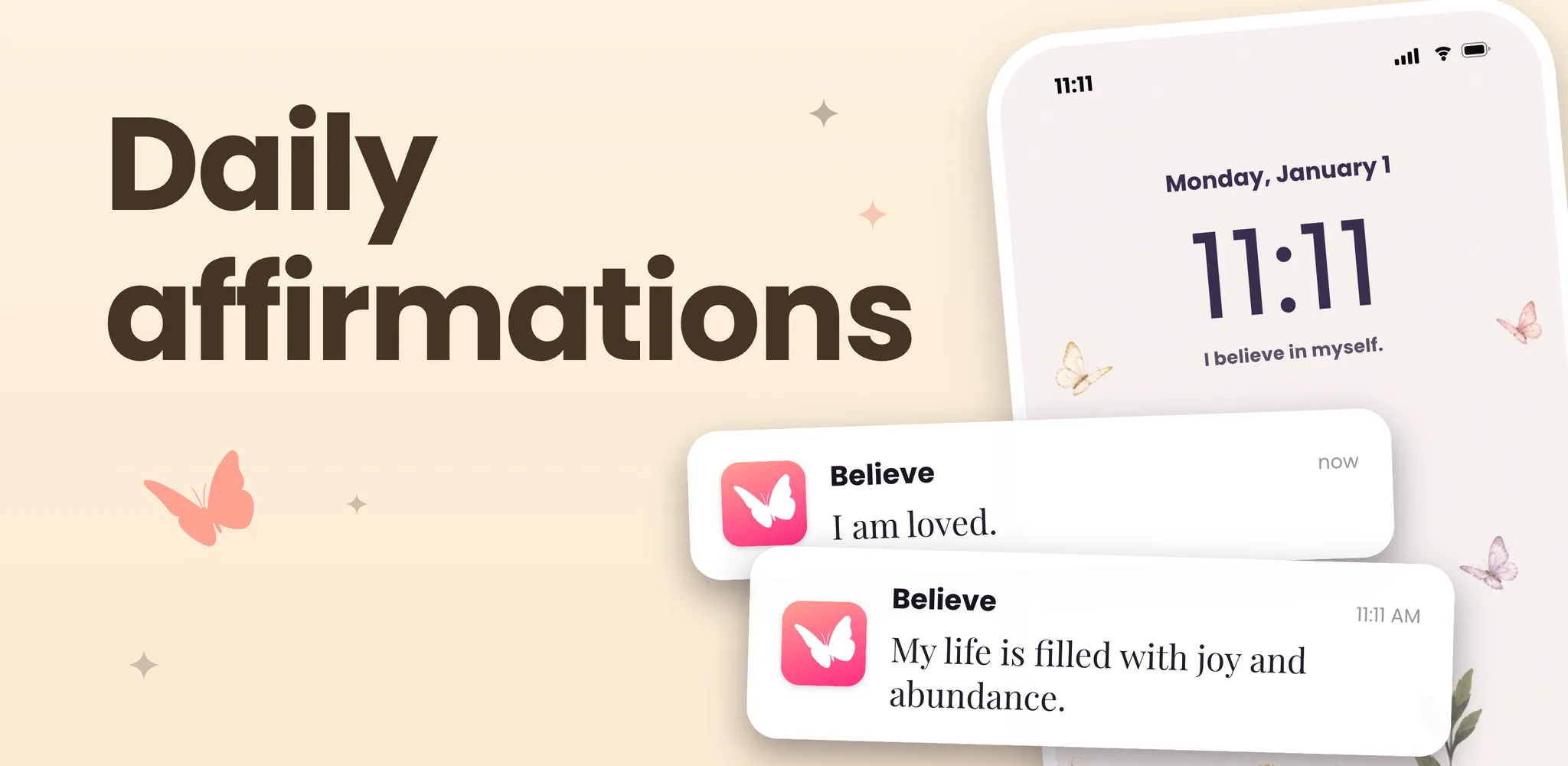
All five of these affirmation apps have been on my phone at the same time. What I remember isn’t what made them different. It’s how fast they blurred together: the wallpapers change, the fonts change, and underneath sits the same set of sentences about worthiness and abundance, poured into a new gradient every year, wrapped in a subscription, and shipped.
The differences that matter aren’t in the words. They’re in what the app lets you do with them, where it puts them during your day, and what it charges once the trial ends. That’s what this comparison measures.
Disclosure: Believe, the app ranked first here, is made by the team behind this site.
How we judged these
Four questions decided the order:
- Can you make it yours? An affirmation you scroll past is a quote. One you wrote, or recorded in your own voice, or said to your own reflection, is a different object entirely.
- Does it reach you during a real day? Not a spa morning. A Tuesday. Widgets, lock screens, a watch face, notifications that arrive while you’re stuck somewhere.
- What does it cost after the trial? All five are free to download. None of them stay free.
- Is it still open in month two? This is the only question that really matters, and it’s the one most roundups skip.
Ranked against those four, the order below doesn’t match the download charts.
The five at a glance
| App | Best for | Standout | Get it |
|---|---|---|---|
| Believe | The most complete practice | Affirmation Mirror, voice recording, widgets, watch | iOS · Android |
| I am | Sheer scale | 728,000 ratings, huge library | iOS · Android |
| Gratitude | Journaling and vision boards | Vision board, guided challenges | iOS · Android |
| Innertune | Passive listening | Audio playlists that run while you sleep | iOS · Android |
| ThinkUp | Voice recording, if that’s all you want | Record and replay over music | iOS · Android |
1. Believe: Daily Affirmations
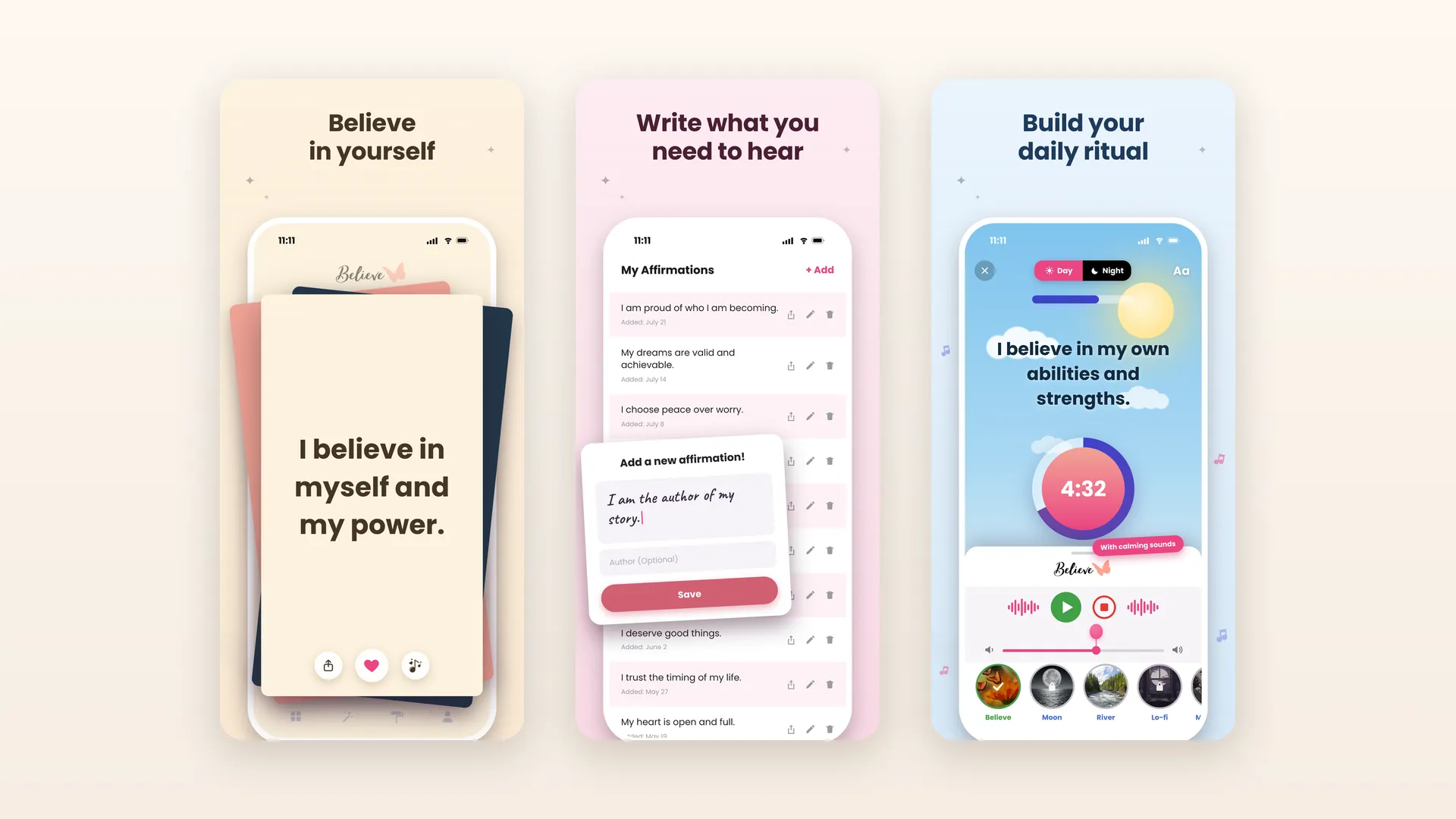
Believe ranks first because it’s the only app here that doesn’t force a trade. Most of these apps are built around one good idea. Believe carries the good ideas from all of them and adds one nobody else has.
What sets it apart
The Affirmation Mirror puts your own face behind the words while you say them. No other app on this list has anything like it, and it changes the exercise completely. Reading “I am enough” on a gradient is a different act from saying it while looking yourself in the eyes.
The voice recorder lets you record affirmations in your own voice and replay them, which is the entire premise ThinkUp is built on. Timed practice sessions with ambient music and medal milestones give the repetition somewhere to go, so you can sit with one line for four minutes instead of consuming forty in four. A gratitude journal covers the ground Gratitude specializes in. More than 10,000 affirmations across dozens of categories answers the library question that makes I am popular.
Then there’s reach: home screen widgets, lock screen text, and an Apple Watch face, so the affirmation finds you at a stop light or in an elevator instead of waiting for you to remember it. Add 300+ themes, dark and light modes, and full English and Spanish, and the practical answer to “which one should I install” gets short.
The best affirmation app is the one that makes you stop for four seconds and actually mean it. Everything else is decoration.
Where it gives ground
Believe launched in June 2021, which makes it younger than I am (2014), ThinkUp (2014) and Gratitude (2018). That shows up in one number: 367 ratings on the US App Store against I am’s 728,000. The average is higher, 4.9 against 4.8, but the crowd is smaller, and for some people the crowd is the point. It also has no vision board, so if a visual collage is central to how you practice, Gratitude does that and Believe doesn’t.
Get it: App Store · Google Play
2. I am: Best for sheer scale
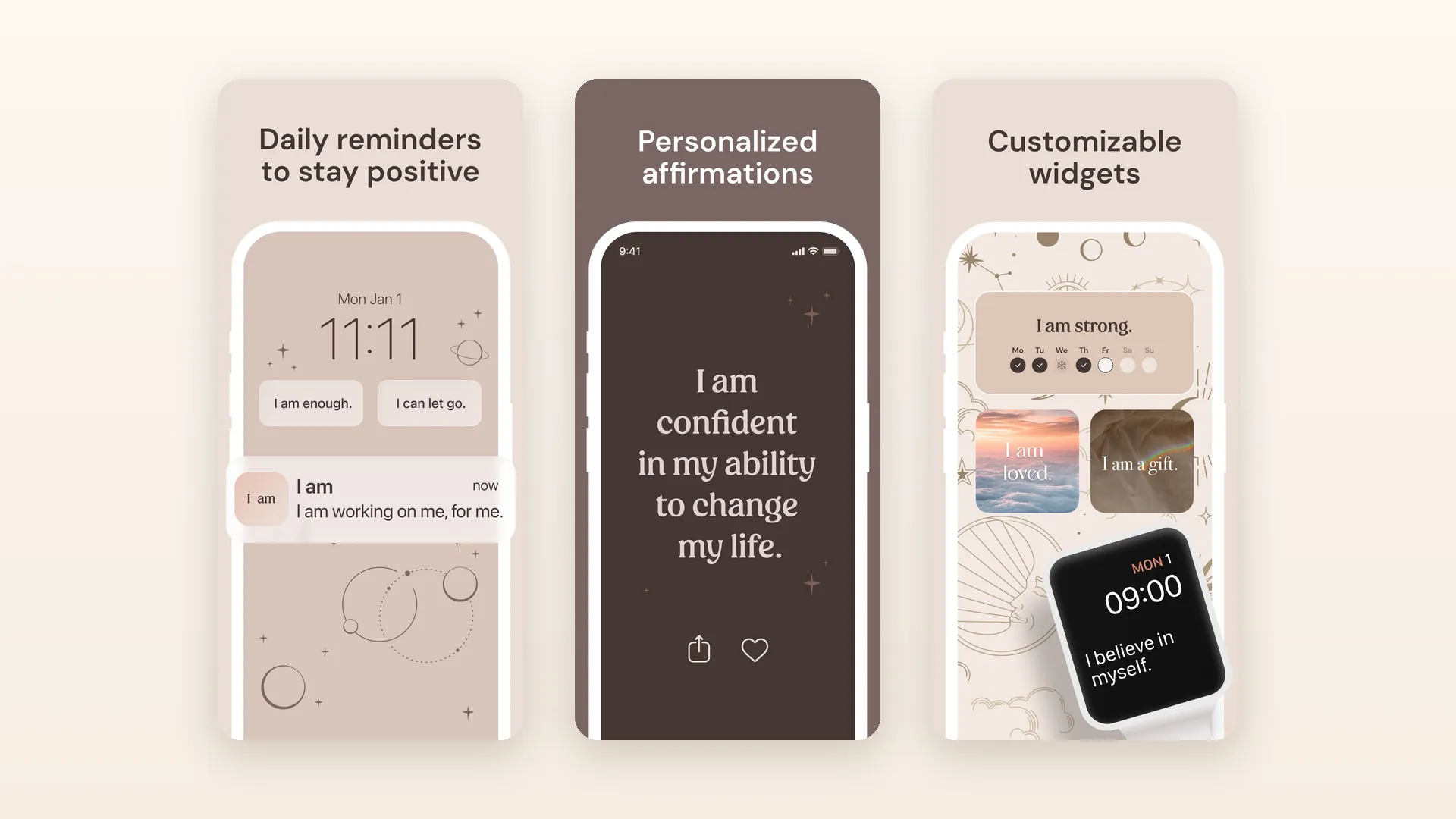
I am is the category. On the App Store since May 2014, 728,000 ratings at 4.8 stars, and the app most people mean when they say “affirmation app.” The library is enormous, the typography is lovely, the widgets and lock screen delivery are excellent, and the notification cadence is tuned by a team that has studied this for over a decade.
Where it wins
Nothing else here has that much social proof, and social proof is a real reason to trust an app with a daily habit. If you want zero decisions and a beautiful sentence appearing on your lock screen with no input from you, I am does that better than anyone.
Where it falls short
The relationship stays one-directional. You receive affirmations, you rarely make them, and after a few months many people report reading them the way they read a headline. There’s no mirror, no timed session structure, and no journal. Google Play also lists its in-app purchases running up to around $170, the highest ceiling in this group.
3. Gratitude: Best for journaling and vision boards
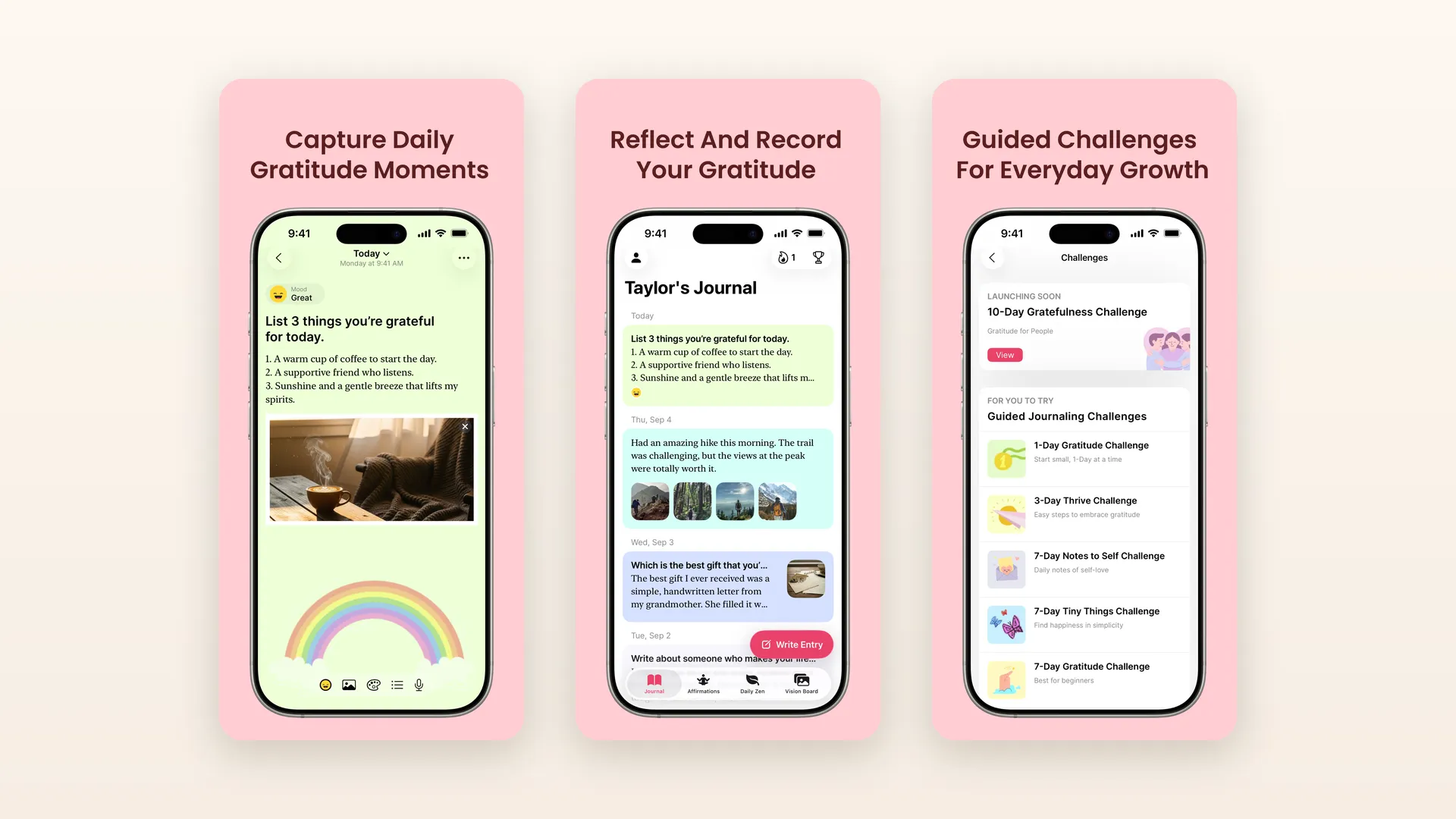
If affirmations at a mirror have never done much for you, the format may be the problem rather than the practice, and Gratitude is the strongest alternative here. It wraps affirmations inside a journal, a vision board, and guided challenges, so the affirmation arrives attached to something you actually wrote about your own week.
Where it wins
The vision board is genuine, and it’s the one feature in this roundup that Believe doesn’t answer. Journaling depth is real too: photo entries, voice journals, and prompts better than most dedicated journaling apps. 4.9 stars across nearly 45,000 ratings since 2018.
Where it falls short
Affirmations are one module inside a larger self-care product rather than the point of it, so a focused daily affirmation habit means navigating past a lot of other features. Pairing it with a structured 30-day approach helps, because the app won’t push you toward one specific practice on its own.
4. Innertune: Best for passive listening
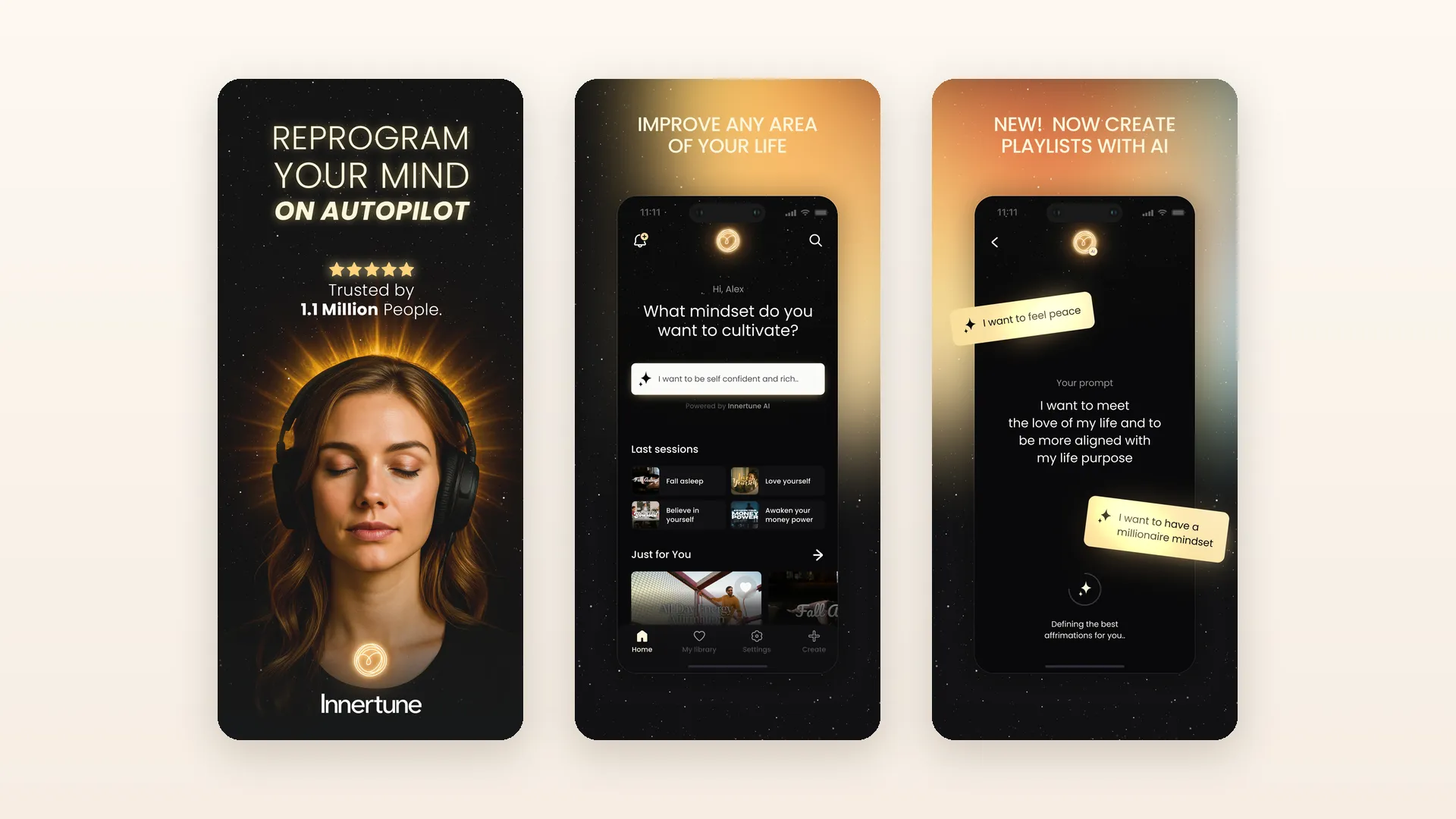
Innertune is the newest here, released November 2022, and it goes audio-first. You build playlists of spoken affirmations layered over music and let them run while you work, drive, or sleep. At 4.8 stars across 11,500 ratings, plenty of people find that it fits them.
Where it wins
Passive playback genuinely suits anyone already listening to podcasts or ambient audio for hours a day, and meeting an existing habit beats fighting one. Believe has ambient music inside its sessions, but it doesn’t do standalone sleep playlists, so this is a real distinction.
Where it falls short
Passive is the design and passive is the failure mode. Audio playing near you isn’t the same as deciding to mean something, and if it fades into background noise you get nothing while noticing nothing. It also has no Apple Watch app, which rules out the wrist entirely.
5. ThinkUp: The original voice-recording app
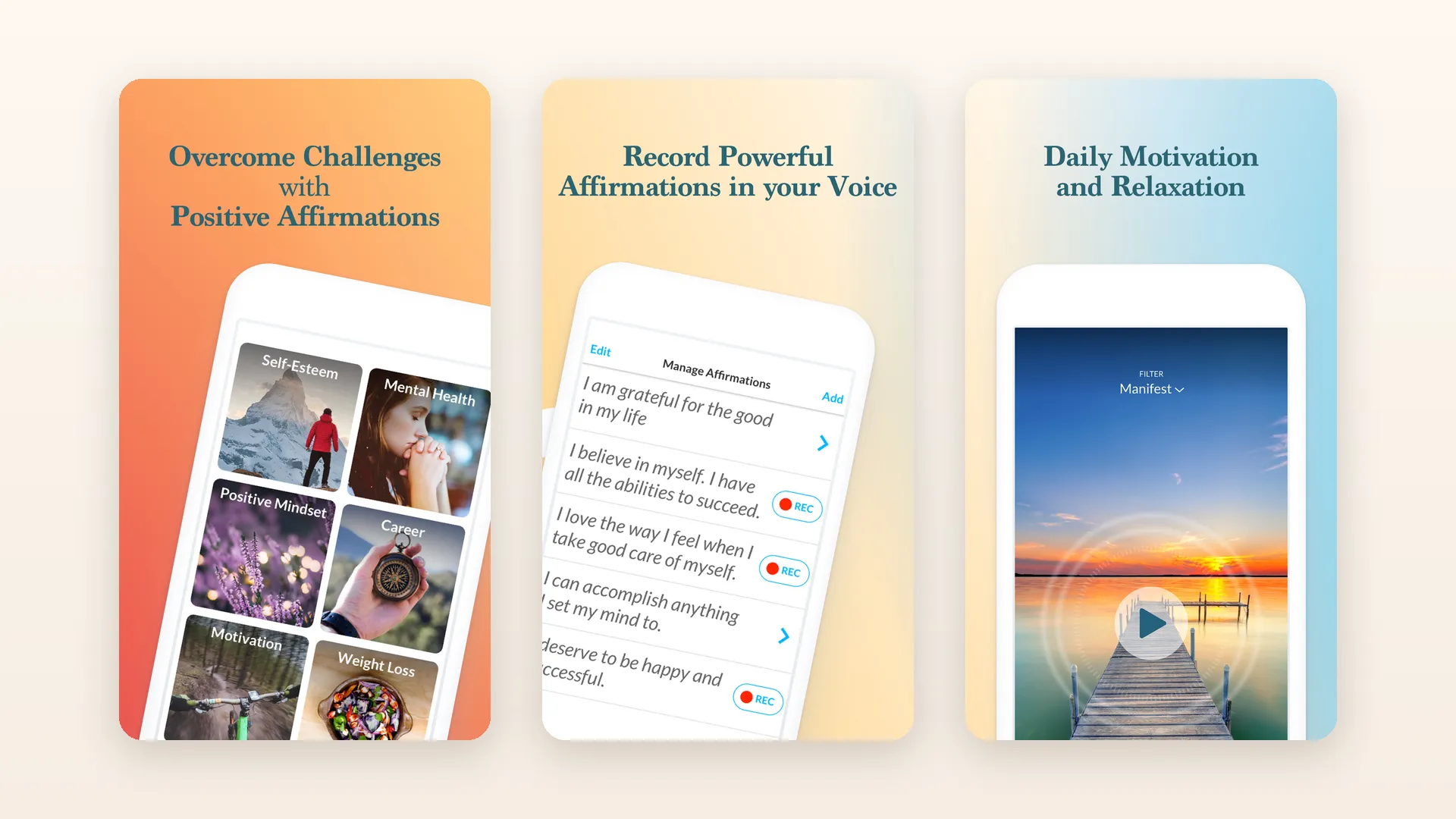
ThinkUp arrived in December 2014 and built its reputation on one idea: record affirmations yourself, in your own voice, and play them back over music. Hearing your own voice tell you something is a materially different experience from reading it in someone else’s font, and ThinkUp got there first.
Where it falls short
That idea isn’t its own anymore. Voice recording now ships in Believe, Gratitude and Innertune as well, so there’s much less reason to pick ThinkUp specifically. The interface shows its age next to Gratitude or I am, the curated library is smaller, and it holds 7,500 ratings against competitors with tens or hundreds of thousands. It ranks fifth because everything it does well, something else on this list also does, usually alongside more.
Also worth knowing: Mantra
Mantra missed the list on a technicality. Around since February 2017, 4.8 stars across 34,000 ratings, and its widgets are among the prettiest on iOS. It’s not in the five because it’s iPhone only, and roughly half of the people reading this are on Android.
Widgets, lock screens and the wrist
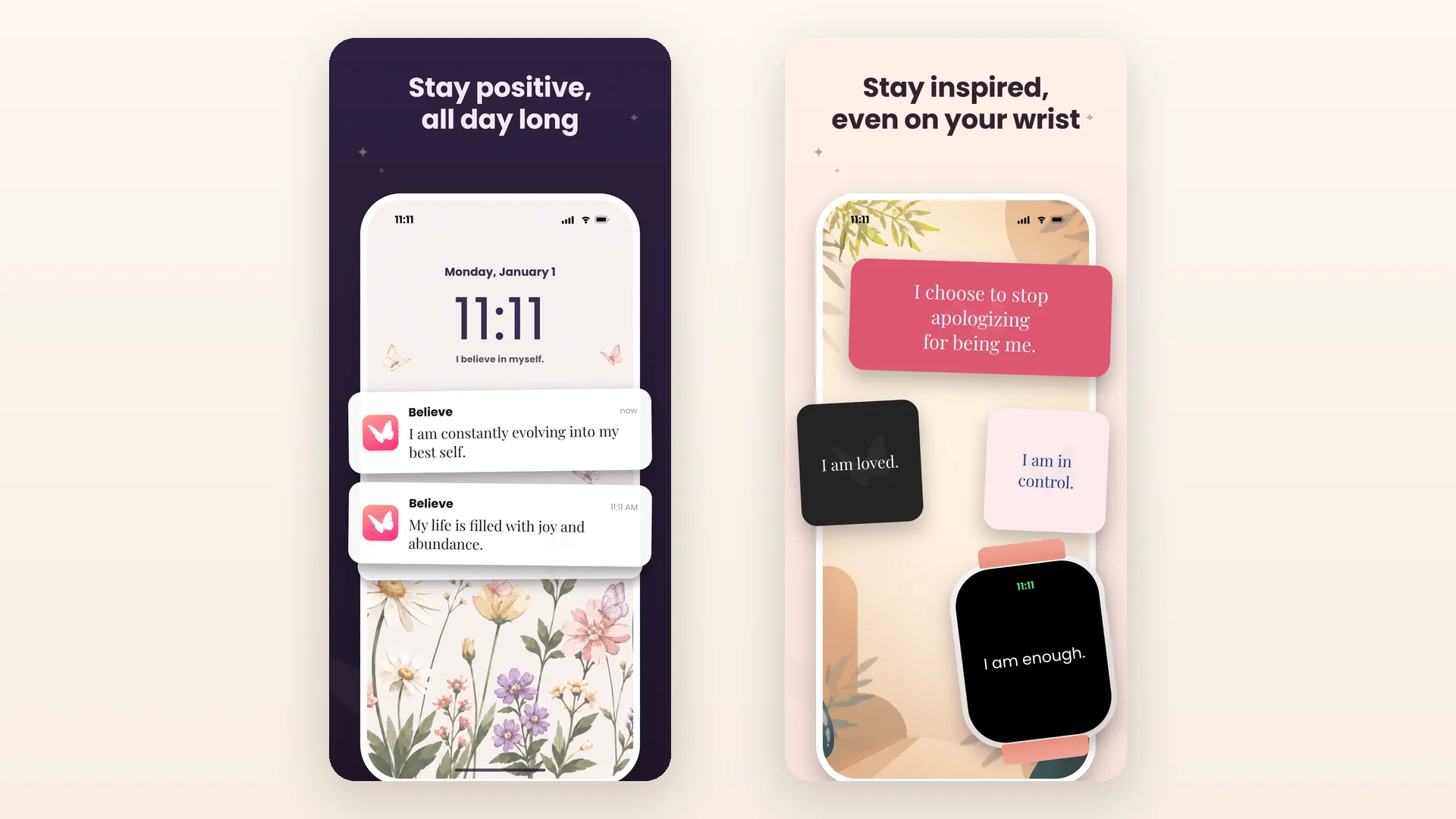
This is where most people underestimate the decision. Search the App Store for “affirmation” and the top suggestions after the category name itself are affirmation widget, affirmation lock screen and affirmation reminder. People aren’t really shopping for sentences. They’re shopping for delivery.
The research backs the instinct. A University College London study on habit formation found that automaticity builds through repeating a behavior in a consistent context, and took a median of 66 days to plateau. Two things follow from that. The cue matters as much as the action, and month two is precisely when the habit is still being built rather than finished.
The affirmations that stuck for me were never the ones I sat down to read. They were the ones that showed up at a stop light, in an elevator, while a build was running. An affirmation you have to remember to open is one you’ll stop opening around week three. One already sitting on your lock screen when you check the time has no activation cost at all, which is why the ones that work are the ones you feel in the moment rather than the ones you schedule and forget.
Only two apps here cover all three surfaces properly. Believe offers home screen widgets, lock screen affirmations and an Apple Watch face. I am matches it with widgets, lock screen delivery and a watch app. Innertune has no watch app at all. Before you commit to any affirmation app, check the widget and lock screen support specifically, because that’s the feature that decides whether you’re still using it in month two.
Covers all three: Believe on App Store and Google Play
What’s free, and what isn’t
All five apps are free to download, and all five put their best features behind a subscription. That’s the business and it’s fine. What’s less fine is how hard several of them make it to see the real number before you commit.
On the free tier you can generally expect a limited daily affirmation or two, a small slice of the categories, and basic reminders. The things people actually stay for, the full library, the mirror, voice recording, unlimited categories, premium themes and most widget customization, sit behind the paywall in every app here.
Listed in-app purchase ranges on Google Play top out anywhere from roughly $50 to roughly $170 depending on the app, which tells you how much variation hides behind five identical-looking “Start free trial” buttons. Before subscribing to any of them, find the annual price rather than the monthly one, check whether a lifetime option exists, and set a calendar reminder for the day before the trial ends. Doing that once saves more than most of these apps cost.
How to choose
Pick by the way you want to practice, not by the download count.
- You want the most capable app and the fewest compromises: Believe.
- Social proof and the biggest possible library matter most: I am.
- A vision board and deep journaling are central to how you practice: Gratitude.
- You want it playing in the background while you sleep or work: Innertune.
- You only care about recording your own voice: ThinkUp, though Believe does this too.
Then delete the other four. Four affirmation apps on one phone is a way of practicing none of them, and I say that as someone whose home screen looked exactly like that for a while.
The app is not the practice
Most of these apps feel interchangeable because most of them stopped at the same idea: show a nice sentence on a nice background. The ones worth keeping are the ones that give the sentence somewhere to land, through your own voice, your own reflection, your own words, on a screen you were already looking at.
That’s a smaller promise than the App Store descriptions make, and it’s the one that holds up. So pick one and give it long enough for the cue to start doing the work for you. Sixty-six days, if the research is right, though you’ll probably notice something shift well before then.
The app is only scaffolding. What you’re building is the habit of talking to yourself like someone worth believing.